








Surpasses $79,000 to Reach 3-Month High
Trump Urges Passage of CLARITY Act
Directly Linked to Resolving Regulatory and Oversight Uncertainty
Congressional Vote on September 15 Serves as Turning Point
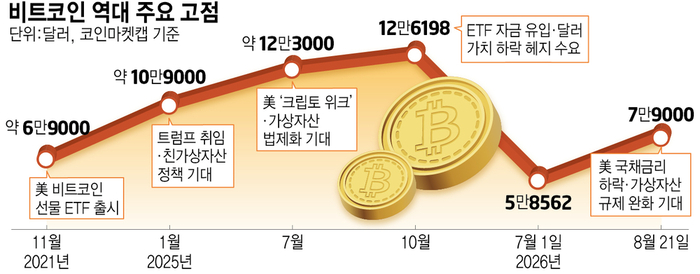
Bitcoin is continuing its strong run in the $77,000 range after soaring to the $79,000 level. With move toward cryptocurrency deregulation by the Donald Trump administration lifting investor sentiment, attention is focused on whether the upward trend will persist.
According to CoinMarketCap on August 23, Bitcoin was trading at around $77,200 as of 9:40 a.m. that day. After surpassing $75,000 on the morning of August 21, Bitcoin surged to the $79,000 level intraday, recording its highest level in three months. Although it later gave back some of its gains, it has maintained the $77,000 range. This is the result of long-term interest rates and the US dollar falling temporarily following the US Department of the Treasury's announcement of expanded buybacks for long-term Treasury bonds, coupled with expectations for cryptocurrency deregulation.
The figure who ignited expectations for cryptocurrency policy was President Trump. Trump met with executives from major cryptocurrency companies, including Coinbase, Robinhood, and Kraken, at the White House last week and urged Congress to pass the Digital Asset Market Clarity Act (CLARITY Act), a cryptocurrency market structure bill.
The CLARITY Act is legislation that establishes regulatory standards and oversight frameworks for the US cryptocurrency market. Its core is to set criteria for classifying whether a cryptocurrency is a “security” or a “commodity” and to clarify whether the US Securities and Exchange Commission (SEC) or the Commodity Futures Trading Commission (CFTC) will oversee it. This is directly linked to resolving regulatory uncertainty, which the cryptocurrency industry has long demanded.
The bill passed the House of Representatives in July last year with 294 votes in favor and 134 opposed. It was subsequently sent to the Senate, but its passage was delayed due to differences of opinion between the ruling and opposition parties.
The next turning point for the continuation of Bitcoin's upward momentum and the passage of the CLARITY Act is September 15. A vote on cloture requested by John Thune, US Senate Majority Leader, is scheduled for that day. To advance the deliberation of the bill, 60 votes are required, meaning the Republican Party alone is insufficient and cooperation from the Democratic Party is necessary. If the vote fails, the likelihood of passage within the year will also diminish.

There are quite a few contentious issues. Democrats and some Republican lawmakers are demanding stronger “conflict-of-interest prevention measures” to prevent public officials, including the President, from profiting through cryptocurrency businesses. Arguments for strengthening anti-money laundering regulations are also emerging. Regarding the payout of stablecoin rewards, the interests of the banking sector and the cryptocurrency industry are in conflict.
While congressional passage of the bill is delayed, US financial authorities are accelerating deregulation on their own. On August 18, the SEC proposed a new regulation that exempts cryptocurrency issuances meeting certain requirements from mandatory existing securities registration. It includes measures allowing cryptocurrency companies to issue tokens worth up to $5 million over four years or raise up to $75 million over 12 months.
The CFTC is also moving to reorganize derivatives regulations related to digital assets. Trump stated at the White House meeting that the CFTC is working to introduce perpetual futures trading, represented by Hyperliquid, into the US market. Aside from congressional legislation, the SEC and CFTC taking steps toward institutionalization reconfirmed the US government's pro-cryptocurrency policy stance.
Market attention is focused on whether this rebound will lead to a trend reversal. In the short term, Federal Reserve Chair Kevin Warsh's Jackson Hole speech on August 28 and the movements of US Treasury yields and the dollar are cited as variables that will determine further Bitcoin gains, while in the medium to long term, the passage of the CLARITY Act and follow-up policies from the SEC and CFTC are considered key factors.
Hong Sung-wook, researcher at NH Investment & Securities, said, “Although Trump urged the passage of the CLARITY Act, the possibility of its passage within the year remains low,” adding, “Ethics and conflict-of-interest issues related to Trump himself are among the biggest obstacles.”
