







The banking sector is enhancing its anti-money laundering (AML) systems for virtual assets. By tracking blockchain fund movements and advancing AI-based analysis and reporting of suspicious transactions, financial institutions are responding to the proliferation of digital assets.
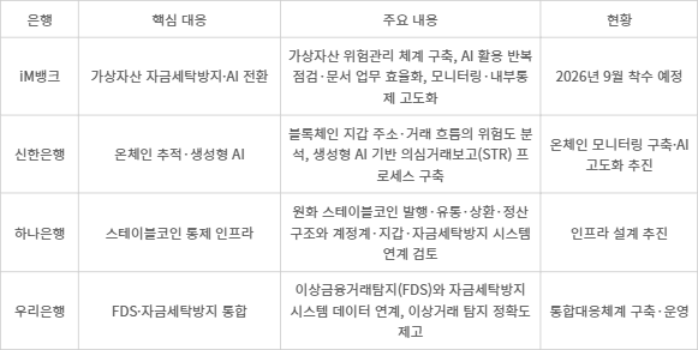
According to the financial sector on the 30th, iM Bank will begin upgrading its AML system, including virtual assets, in September. The bank will establish a risk management framework for virtual assets, reorganize existing transaction monitoring, and internal controls. It will also apply AI transformation (AX) to AML tasks, improving efficiency in repetitive checks and documentation.
Virtual assets can move from bank accounts to exchanges, then to overseas exchanges or personal wallets, making it difficult to trace the entire fund flow using traditional financial transaction data alone. This is why banks are strengthening blockchain transaction analysis and integrating it with customer and account information for better control.
Shinhan Bank has become the first in the banking sector to establish an “on-chain monitoring” system for virtual assets. By analyzing blockchain wallet addresses and transaction flows, the bank identifies risk signals such as addresses linked to criminal activities or high-risk entities. It has also started building a Suspicious Transaction Report (STR) process based on generative AI. The AI assists in report drafting and routine checks, allowing staff to focus on high-risk transaction analysis and decision-making.
Hana Bank is preparing for the introduction of KRW stablecoins by working on connecting digital currency infrastructure with existing banking systems. It is reviewing ways to integrate wallet systems and AML controls with bank operations, covering issuance, distribution, redemption, and settlement. Woori Bank has also built an integrated response system linking its financial fraud detection system (FDS) with AML data to improve the accuracy of detecting anomalous transactions.
Banks are accelerating these systems as external movements of virtual assets increase. According to the Financial Intelligence Unit (FIU) and the Financial Supervisory Service, virtual assets transferred out of domestic exchanges in the second half of last year amounted to 107.3 trillion KRW, a 6% increase from the first half. Of this, 90 trillion KRW was transferred to overseas entities and personal wallets, a 14% rise.
Regulations are also tightening. The government recently passed an amendment to the Enforcement Decree of the Specific Financial Information Act, abolishing the 1 million KRW threshold for the Travel Rule previously applied to domestic virtual asset transfers. It plans to impose differentiated AML obligations based on risk levels for transactions with overseas virtual asset businesses and personal wallets. The revised regulations will take effect six months after their announcement.
As a result, banks' AML systems are evolving beyond mere regulatory compliance into core control infrastructures for expanding digital asset businesses.
A financial sector official stated, “Stablecoins and blockchain-based remittance and payment systems are spreading,” adding, “The ability to track blockchain fund flows and use AI to identify risky transactions will determine a bank's competitiveness in digital assets, so we are accelerating infrastructure development.”