







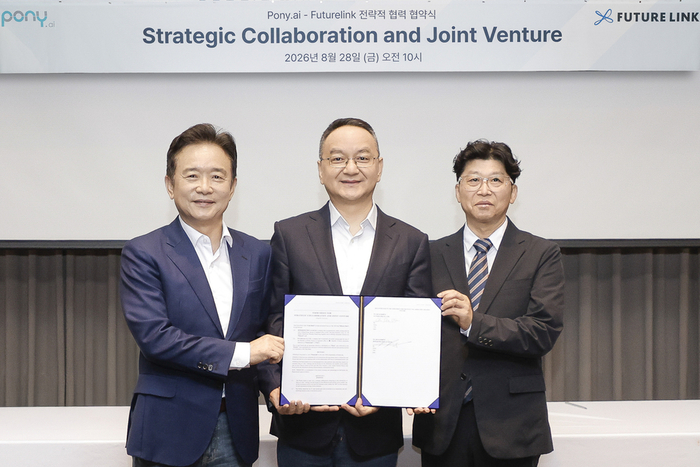
Nam Kyung-pil, chairman of PonyLink (from left), James Peng, chairman of Pony.ai, and Cha Doo-won, CEO of FutureLink, take a commemorative photo holding a strategic collaboration agreement.
Pony.ai, a global Level 4 (L4) autonomous driving leader that spearheaded the commercialization of fully driverless robotaxis in the United States and China, is making a surprise deployment of 200 commercialized vehicles into the South Korean market. With the announced deployment of the “7th-generation mass-produced robotaxi,” which reduced cost by 70%, the stagnant clock of domestic autonomous driving commercialization is expected to accelerate rapidly while triggering fierce competition for market dominance with native autonomous driving camps.
FutureLink and Pony.ai signed a Strategic Collaboration and Joint Venture agreement at Conrad Seoul on the 28th and disclosed a detailed roadmap for entering the South Korean market. FutureLink is an autonomous driving business subsidiary of PonyLink, a Kosdaq-listed company in which Pony.ai holds an equity stake.
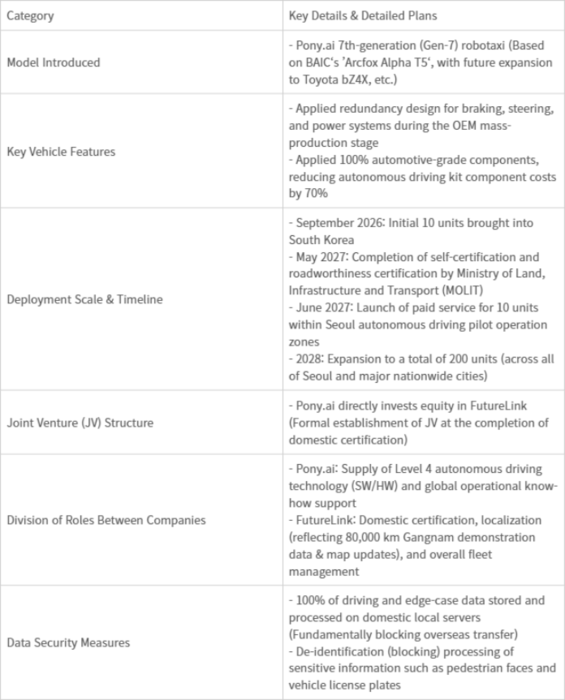
The two companies will deploy Pony.ai's latest 7th-generation robotaxis (based on Beijing Automotive Group's Arcfox Alpha T5) into South Korea, totaling 200 units. The plan is to bring an initial batch of 10 units into the country next month, complete self-certification and roadworthiness certification with the Ministry of Land, Infrastructure and Transport by May next year, and operate them within the Seoul pilot operation zone starting June next year.
Thereafter, they plan to increase the volume in stages to deploy 200 units by 2028 and expand operations across all of Seoul and major cities nationwide. At the point when certification is completed, they will also finalize the establishment of a joint venture (JV) in which Pony.ai directly invests in FutureLink.
Unlike conventional modification methods that add sensors and computers, the 7th-generation model applies redundant design for braking, steering, and power systems starting from the vehicle manufacturing stage, securing driverless operation stability without human intervention. Pony.ai applied 100% automotive-grade components to cut the cost of the autonomous driving kit by 70% compared to the previous generation, and plans to diversify base vehicle models such as the Toyota bZ4X in the future.
Industry insiders expect the fast moves of the global company to generate a powerful “catfish effect” that accelerates the driverless commercialization of the domestic L4 market, which currently remains at the level of requiring safety operators on board at all times.
At the same time, a sense of crisis has heightened. Currently, the domestic autonomous driving market lacks B2C revenue-generating transport models, forcing native startups such as Autonomous A2Z, RideFlux, and Hyundai Motor Group's 42dot to rely on public demonstration budgets (B2G) within local government pilot operation zones.
Under these circumstances, if foreign Big Tech leveraging unit price reductions through mass production and large-scale global references targets local government procurement and licensing markets through joint ventures, early-stage domestic companies could be pushed out in bidding wars and wither away. National “data security” aspects, such as prohibitions on exporting high-definition road maps and de-identification of video data, are also points of concern.
Kim Pil-soo, professor at Daelim University, emphasized, “We must strengthen the post-security audit system that fundamentally blocks overseas leakage of data,” adding, “At the same time, in local government public procurement projects where tax dollars are invested, policy safeguards such as evaluating industrial contribution to protect companies holding domestic source technologies must be prepared in parallel.”
Regarding this controversy, Nam, chairman of FutureLink and PonyLink, argued, “Just as Samsung led foldable phones because Apple existed, introducing advanced technology and localizing it is the path to ecosystem development.” Cha, CEO of FutureLink, also said, “Through 80,000 kilometers of demonstration in the Gangnam area, we confirmed they are the optimal partner,” adding, “We must learn what needs to be learned and generate profitability.”
They drew a firm line against concerns over the controversial issue of “data security.” Yoon Seung-hyun, managing director at FutureLink, explained, “There is absolutely no overseas transfer of driving data collected in South Korea,” adding, “All data is processed on domestic local servers, and sensitive information such as pedestrian faces and vehicle license plates is thoroughly de-identified.”