









As the implementation of virtual asset taxation approaches next year, voices are growing to revise the current system, which groups profits from fundamentally different activities—such as trading, lending, and mining—under a single “other income” category. Arguments are emerging that the tax framework should be restructured, for instance, by classifying capital gains from trading as transfer income and recurring mining profits as business income.
At the forum, participants commonly pointed out that the current classification of virtual asset income as “other income” fails to reflect market realities. Before discussing another postponement, they emphasized the need to first assess whether the existing law can properly capture and calculate diverse virtual asset incomes.
Under the current Income Tax Act, income from transferring or lending virtual assets will be separately taxed as “other income” starting January 1, 2025. After deducting 2.5 million won from annual net gains, a 20% tax rate applies to the excess, with a real tax rate of 22% including local income tax.
Although the system has been postponed three times since its 2020 introduction, its basic structure remains unchanged. The law defines taxable subjects as “transfer or lending” of virtual assets and categorizes all related income as “other income.”
However, the current virtual asset market generates profits through various methods beyond simple trading, including mining, staking, lending, deposit, liquidity provision, airdrops, and hard forks. Staking and liquidity provision involve complex transactions combining asset provision, reward receipt, and price fluctuations. It is also unclear whether virtual assets received via airdrops or hard forks should be treated as income or gifts.
Park Jong-soo, president of the Korean Tax Law Society and a professor at Korea University Law School, stated, “The key question is whether the current law can properly tax these activities.” He added, “Rather than treating all virtual assets under a single label, tax criteria should be reviewed based on transaction functions—such as trading, mining, staking, lending, and liquidity provision.”
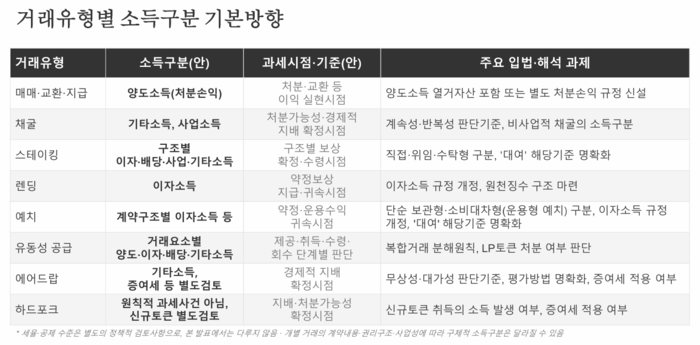
The proposal suggested classifying gains from △sales/exchanges as capital gains, △lending/deposit-type rewards as interest income, △profit-sharing-type rewards as dividend income, △mining conducted as a business as business income, and △temporary rewards as other income. For transactions combining multiple actions, such as staking and liquidity provision, the nature of income should be determined by separating each component.
Classifying virtual assets as “other income” raises equity issues with other investment assets. While capital gains from small shareholders trading listed domestic stocks on exchanges are generally tax-exempt, virtual assets are taxed if annual net profits exceed KRW2.5 million, regardless of investment size. Profits from trading overseas virtual asset spot ETFs are classified as “overseas stock capital gains,” whereas profits from direct trading on domestic exchanges fall under “other income.”
Gaps may also arise in carryover tax provisions designed to prevent tax avoidance. Current tax law applies carryover taxation to prevent inflating acquisition costs by gifting capital gains-taxable assets to spouses or direct lineal descendants before selling them. However, since virtual asset trading gains are categorized as “other income” rather than capital gains, they are not subject to this regulation.

Kim Tae-kyung, a legislative researcher at the National Assembly Research Service, stated, “At the time of the 2020 legislation, virtual assets were strongly perceived as speculative, which likely influenced their income classification. Given the significant changes in the institutional and economic environment surrounding virtual assets, it is necessary to re-examine whether maintaining the original classification remains appropriate.”
Google Maps, Default Apps Propel MAU Past 10 Million...Aggressive Push in Domestic Market Intensifies
Professor Park proposed an alternative system tentatively named the 'Virtual Asset Investment Income Tax.' This approach would categorize income sources as follows: capital gains for trading, interest income for lending, dividend income for profit-sharing rewards, business income for commercial mining, and miscellaneous income for one-time rewards—while consolidating calculation, reporting, and documentation procedures into a single system. He emphasized, “Merely continuing the current structure, which uniformly taxes capital gains and rental income as miscellaneous income, is insufficient. Legislative reforms across income classification and tax procedures must precede implementation.”
