








The Korea Exchange (KRX) is set to launch its new after-hours market in one week, widening access to real-time evening trading across most KOSPI- and KOSDAQ-listed shares.
Starting Sep. 14, investors will be able to trade eligible stocks in real time from 4:00 p.m. to 8:00 p.m., after the regular market closes. The expansion is expected to reshape South Korea's evening trading landscape by extending access beyond large, highly liquid stocks to a much broader range of small- and mid-cap shares.
The official name of the new service is after-hours continuous trading. The regular KRX session will continue to run from 9:00 a.m. to 3:30 p.m. The existing after-hours closing-price session, which allows trading at the day's official closing price from 3:40 p.m. to 4:00 p.m., will also remain in place.
The biggest changes involve the range of eligible securities and the order-matching system.
At present, only 604 stocks selected by alternative trading system NextTrade (NXT) can be traded in real time until 8:00 p.m. These are largely actively traded, liquid names, leaving investors in many small- and mid-cap stocks with limited ability to execute trades after the regular session.
Once the KRX after-hours market opens, real-time trading through 8:00 p.m. will be available for most listed common shares on the KOSPI and KOSDAQ markets. Based on recent figures, the KOSPI has 943 listed stocks and the KOSDAQ has 1,822, for a combined total of 2,765.
Even after excluding securities restricted for investor-protection reasons, the number of stocks eligible for after-hours trading is expected to increase by more than 2,000 compared with NXT's current after-hours lineup. Exchange-traded funds (ETFs) and exchange-traded notes (ETNs) will not be eligible.
The trading mechanism will also change. KRX will discontinue its existing after-hours single-price auction market and replace it with continuous order matching from 4:00 p.m. to 8:00 p.m.
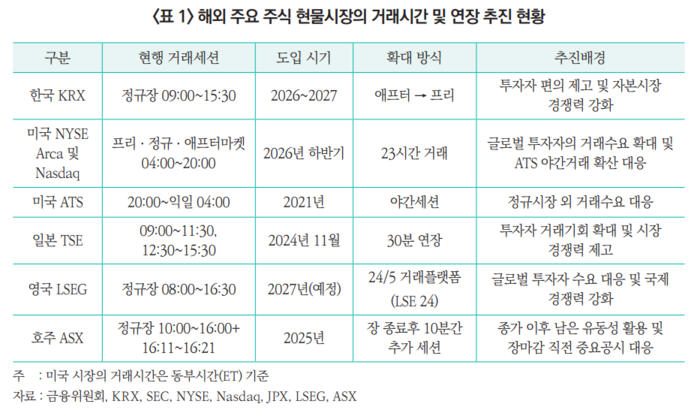
With longer trading hours, however, the market will face a key test: whether liquidity becomes too fragmented.
If the new session does not attract enough additional demand and instead merely splits existing orders across the regular session, the KRX after-hours market, and NXT, order execution could become more difficult and price volatility could increase.
The Korea Capital Market Institute has said that regulators and market operators should closely monitor trading volume, bid-ask spreads, price swings, and gaps between after-hours prices and regular-session closing prices after the new market opens. If problems arise, it said, market surveillance, system-failure response measures, and investor-protection safeguards should be strengthened accordingly.
KRX's entry also increases pressure on NXT, which has effectively dominated South Korea's real-time evening stock trading market.
Once KRX begins trading at 4:00 p.m., NXT's exclusive after-hours window will shrink from 4 hours and 20 minutes to just 20 minutes, from 3:40 p.m. to 4:00 p.m. For the following four hours, the two venues will compete for orders and fee revenue while offering trading in the same stocks.
For NXT, however, the KRX launch could also ease constraints created by its trading-volume cap. Under current rules, NXT's average daily trading volume over the most recent six months cannot exceed 15% of KRX trading volume during the same period.
If KRX's after-hours trading volume grows, the absolute amount of trading NXT can process under that 15% ceiling could rise as well. Greater investor awareness of evening trading—and higher demand for it—could also expand the overall market rather than simply redistribute existing volume.
Yeom Mi-rim, a senior research fellow at the Korea Capital Market Institute, said that longer trading hours in South Korea's stock market should be introduced gradually, alongside upgrades to market operations, in order to preserve market stability and investor protection.
