








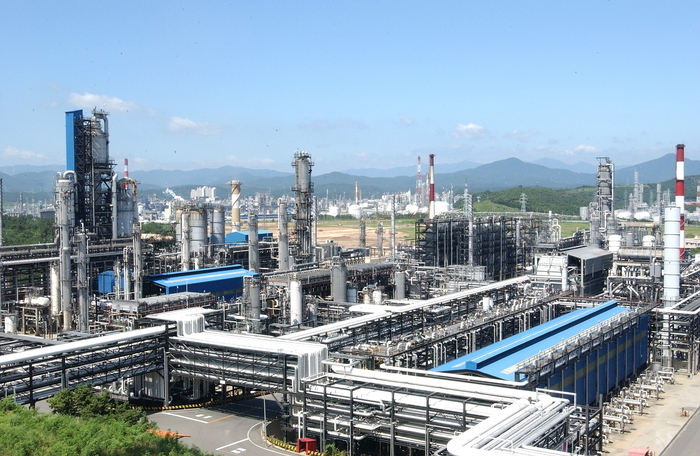
SK Innovation is deploying its “Dual Brain” operating model at its Ulsan Complex, or Ulsan CLX, as it accelerates the use of artificial intelligence across its refining and petrochemical operations.
The company's aim is to combine “Brain AI” with the expertise of on-site engineers — the “Human Brain” — to run the industrial complex with greater precision, safety and efficiency. SK Innovation plans to transition Ulsan CLX into an AI-centered organization by 2030.
During a Sep. 10 visit to the complex, the site appeared as a dense expanse of pipelines, processing units and industrial infrastructure spread across an area roughly three times the size of Seoul's Yeouido district. Founded in 1964 as South Korea's first oil refinery and chemical plant, Ulsan CLX is now the country's largest crude-processing complex, with capacity to handle 840,000 barrels of crude oil per day.
Six decades of expansion have also made operations increasingly difficult to manage. The complex identifies three key challenges: process complexity, blind spots in physical monitoring and the need to turn accumulated field experience into usable data.
Its 98 interconnected process units create a tightly linked production system in which a change in operating conditions at one unit can affect output volume, product quality and yield elsewhere. About 3,000 workers move through the site each day, while roughly 330,000 maintenance and repair tasks are carried out annually across the sprawling complex. That scale creates inherent limits for visual inspection and leaves areas that workers cannot continuously monitor.
SK Innovation is applying the Dual Brain model primarily in major control rooms, including those for its heavy oil upgrading, or HOU, process.
One side of the model, Brain AI, acts as a round-the-clock analytics and decision-support engine. It monitors real-time process and equipment data, detects signs of anomalies and proposes preventive actions or operating responses. On the other side, experienced field engineers assess the AI's recommendations, make the final decision and carry out the required action.
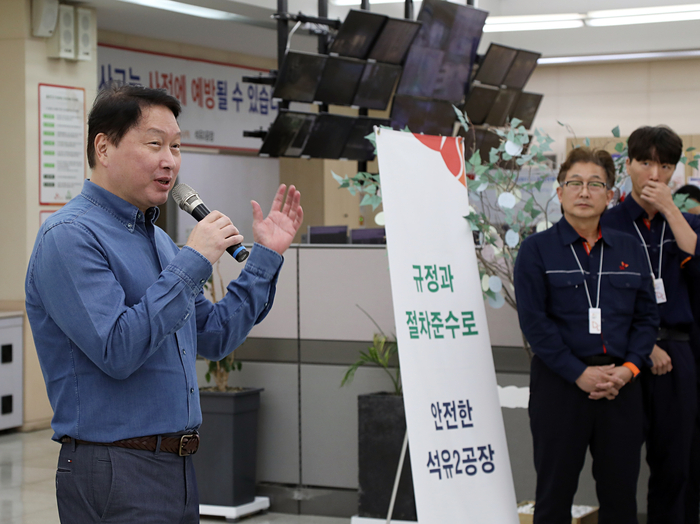
The HOU control room visited on Sep. 10 was filled with hundreds of CCTV feeds, with as many as 1,000 screens available for monitoring. Workers operate the process around the clock through a four-team, two-shift system and respond to emergencies when unexpected variables arise. Each experienced operator typically oversees six to eight areas, watching for risks as conditions change in real time.
The company is currently running pilot projects rather than operating the entire complex through the system. It has formed a task force to test Dual Brain technologies in large-scale, relatively accessible advanced processes such as HOU before expanding them further across the site.
An Ulsan CLX official said employees had spent the past two years studying AI and developing their own AI models. The official added that expanding Brain AI could ultimately help create a broader physical AI ecosystem for industrial operations.
By 2030, Ulsan CLX is targeting annual productivity improvements worth roughly 100 billion KRW, while aiming for zero equipment downtime and zero major industrial accidents. The company has begun developing and validating predictive models and connected AI agents this year. It plans to strengthen its data infrastructure in 2027, establish the reliability of Brain AI by 2028 and transform working methods before embedding the Dual Brain operating system more broadly from 2030 onward.
“AI is not replacing people,” said Jung Chang-hoon, head of the Manufacturing AI Team at Ulsan CLX. “It fills the gaps in time and physical coverage that people cannot avoid missing.”
Jung said the company wants to transform Ulsan CLX — which began 60 years ago as South Korea's first refinery — into a plant where people and AI work together through a Dual Brain model over the next 60 years.
