









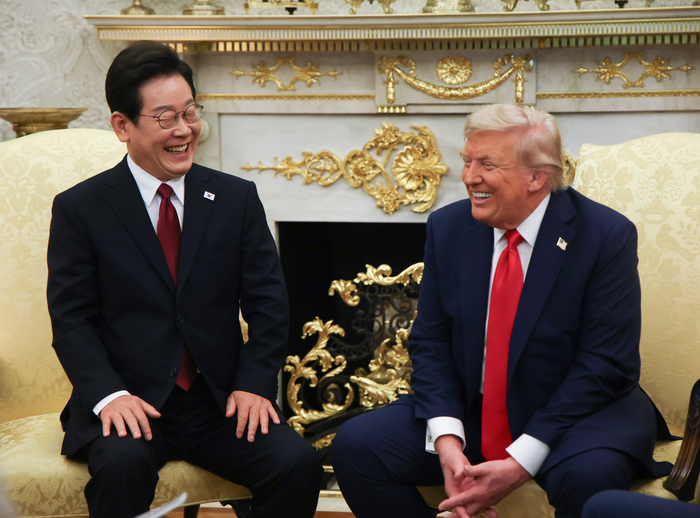
South Korea's agreement on a major investment package for the United States has been thrown into uncertainty, with President Lee Jae-myung personally stepping in to halt negotiations over terms he said would be difficult to accept.
The talks have stalled as Washington presses Seoul to invest in high-risk projects, including the Alaska liquefied natural gas, or LNG, development. The United States has also sought changes to how returns and losses would be allocated across the investment portfolio, along with an accelerated funding schedule.
The dispute concerns the $200 billion strategic-investment portion of South Korea's broader $350 billion commitment to the United States. The wider package includes $150 billion earmarked for shipbuilding cooperation. The $200 billion portion is intended for strategic sectors such as energy, semiconductors, pharmaceuticals, critical minerals and artificial intelligence.
A government briefing to the National Assembly, initially expected on Sept. 17, was postponed. The Ministry of Trade, Industry and Energy is still considering whether to brief the relevant parliamentary committees on Sept. 21 or 22, but no final schedule has been set.
“We are doing everything possible in the negotiations to reach an agreement that serves the national interest,” an Industry Ministry official said, adding that no specific briefing date had yet been confirmed.
President Lee raised the issue publicly at a press conference on Sept. 18. He said working-level officials had reported that the two sides were close to an agreement, but that he found aspects of the proposed terms hard to accept after reviewing the details.
Lee identified investment recovery, profit sharing and loss allocation as the central sticking points. He said the government was negotiating intensively to structure projects in a way that protects South Korea's national interest while benefiting both countries.
The projects reportedly under discussion include a gas-fired combined-cycle power plant in Texas, a framework for building up to eight large nuclear reactors in the United States, and the Alaska LNG project. Reuters reported that the Texas project was estimated at about $22.3 billion, while the Alaska LNG development has been estimated at roughly $44 billion. Other reports have put the proposed Alaska project's potential investment requirement substantially higher, underscoring that the final project list and terms remain unresolved.
Alaska LNG is widely viewed as the most commercially risky option. The project would require a roughly 1,300-kilometer pipeline to carry gas from northern Alaska to Nikiski for export to Asian markets. Its economics are exposed to difficult construction conditions and volatility in natural-gas prices. South Korea has approached the proposal cautiously and has sought to keep it under review without making a binding financial commitment.
Seoul had reportedly considered using an umbrella-style special-purpose vehicle, or SPV, that would pool returns from multiple projects to repay principal and interest. That structure could help offset losses from any single project. However, the United States has reportedly pushed for returns and losses to be calculated separately for each project, a change that could leave South Korea more exposed if a high-risk project performs poorly.
Washington has also reportedly requested that South Korea front-load around $10 billion in investment funding by the end of this year—roughly half of the annual $20 billion ceiling. Seoul has maintained that the $200 billion overall cap and the annual $20 billion limit must be respected.
U.S. pressure has extended beyond the investment negotiations. During their meeting in Washington on Sept. 18, U.S. Secretary of State Marco Rubio and South Korean Foreign Minister Cho Hyun discussed the investment package and broader security issues. Reports indicate that Washington has also raised cooperation on semiconductors and concerns about the business environment for U.S. companies, including issues connected to the investigation of Coupang.
Security concerns in the Middle East are adding further strain. As tensions around the Strait of Hormuz escalate, the United States has urged South Korea to make a greater contribution to protecting freedom of navigation through the key oil-shipping route. Seoul is weighing whether to provide military assets, but President Lee has emphasized a principle of non-involvement in war and has drawn a line against direct participation in a Middle East conflict.
The negotiations are also intertwined with other sensitive security issues between the allies, including South Korea's push for nuclear-powered submarines and questions surrounding nuclear-fuel enrichment and reprocessing. With the investment package still unresolved, a final agreement may remain delayed unless Washington offers more flexible terms on risk-sharing, returns and funding.
