








Humans have been redefined according to how they live in each era—'Homo Sapiens' who think and judge, 'Homo Faber' who create and use tools, and 'Homo Ludens' who play.
As artificial intelligence (AI) evolves into the era of agentic AI, which performs actual actions and tasks, the definition of humanity is also changing. Beyond 'Homo Promptus,' who ask questions and receive answers from AI, 'Homo Agenticus'—who decide what to entrust to AI and verify its actions—has emerged. This concept was coined by Professor Paul Leonardi of UC Santa Barbara in a paper published last year in the international journal *Information and Organization*.
Electronic Times marked its 44th anniversary by examining the present and future of humanity amid AI transformation under the theme 'AI New Humanity Report.' Exactly ten years after 2016, when the newspaper posed the question of 'New Humanity in the Fourth Industrial Revolution' on its 34th anniversary. While the focus then was on how technological advancements like AI, robots, and autonomous vehicles would change human life, now that AI has begun to act, the challenges are about what to delegate to AI, how to control it, and who is responsible.
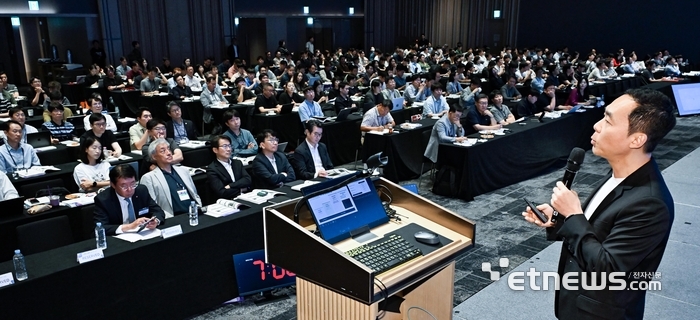
This shift was highlighted at the 'CAIO Summit 2026,' held on the 18th at the Westin Seoul Parnas Hotel in Samseong-dong, Seoul, as part of Electronic Times' 44th-anniversary event. Chief Artificial Intelligence Officers (CAIOs) from major companies discussed how to redefine the roles of AI agents and humans.
Lim Eun-young, head of LG CNS, emphasized, “For agentic AI to operate in enterprises, a system of 'authority, approval, logs, and rollback' is necessary to determine if AI's incorrect actions can be reversed, who approves its actions, and who takes responsibility for the results.”
She added, “As AI performs tasks independently, humans will focus more on setting goals, approving, and reviewing outcomes.”
The transformation into Homo Agenticus is already materializing in development fields. With AI generating code directly, human developers' roles are shifting toward designing environments where AI can work and verifying results. Woo Soo-yeon, an IBM expert, stated, “With the rise of agentic AI, developers are no longer focused on code-level tasks but on designing loops and harnesses for how work continues and planning how to verify outcomes.”
Redesigning corporate workflows and work culture is also critical. As corporate competitiveness depends on how well data and decision-making structures are designed around AI, the role of CAIOs, who are responsible for this, becomes more significant.
Kim Ji-hyun, Vice President of SK Supex AI Committee, advised, “While existing chatbots handled individual 'tasks,' agents can take over entire jobs and become our colleagues. To maintain accelerated work speeds and create results, changes in work systems and methods—'workflow redesign'—are necessary.”
Ha Jung-woo, Vice Chairman of the National AI Strategy Committee, also stated, “For a major AI transition, the role of CAIOs—who understand technology and the field, connect executives, developers, and operational teams, and turn AI into actual business results—is crucial.”
