








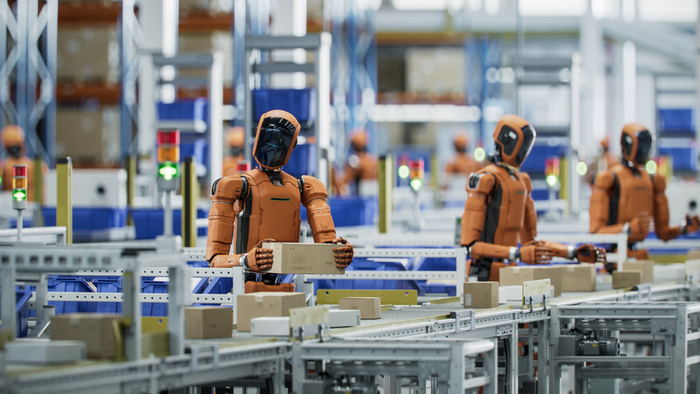
Eight out of the top 10 Chinese humanoid robot manufacturers have secured at least one of the following in South Korea: KC certification, trademarks, or sales channels. As the domestic humanoid market remains in its early stages, Chinese companies are rapidly moving to preemptively establish product certifications, brand rights, and distribution networks.
According to the industrial analysis report *Laps Deep Report* on the 12th, major Chinese humanoid robot companies are testing the Korean market by consecutively obtaining KC radio wave certifications, trademark rights, and sales channels. Top global market shippers have already completed product certifications.
Agebot received KC certification for its humanoid robot *X2 Ultra* under its Chinese headquarters in April and signed an exclusive partnership agreement with Korean company IL just ten days later. Agebot ranked first in global humanoid shipments in the first half of this year.
Unitree obtained certification for its humanoid *G1* under its headquarters in December last year. Booster Robotics also completed KC certification for its small humanoids *T1* and *K1* in January 2025 and April this year, respectively. The fact that Chinese headquarters are directly obtaining certifications instead of domestic importers suggests a strategic move to manage the Korean market as a direct export target.
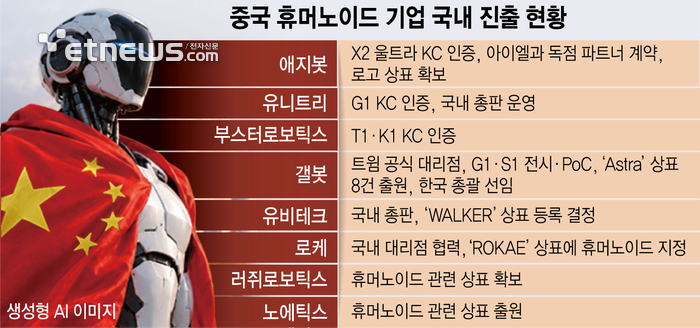
Before body certification, there is an increasing trend of securing trademarks and sales networks first. Galbot, with TWM—a KOSDAQ-listed company—as its official Korean distributor, unveiled its wheeled humanoid 'G1' and industrial 'S1' at a domestic exhibition. TWM has applied its own robot control platform to G1 and is conducting proof of concept (PoC) for domestic clients. Galbot has filed eight trademark applications in Korea under its robot brain and operating system brand 'Astra' and recently appointed a head to oversee its Korean operations.
UbiTech, after securing a domestic distributor, has proceeded with trademark registration for its humanoid brand 'WALKER'. Locke has also included humanoids in the designated goods for the 'ROKAE' trademark registered under a Korean company's name. Large humanoids targeting factories and logistics sites, such as UbiTech's 'Walker S2' and Galbot's 'G1', are still pending KC certification, but pre-sales activities—including trademark filings, distributor agreements, exhibitions, and PoC—are already underway.
The entry of Chinese companies into the Korean market appears to be a proactive phase focused on securing certifications, brand rights, and distribution infrastructure necessary for market entry, rather than a large-scale sales expansion. By filing trademarks not only for complete humanoid products but also for robot brain and operating system brands, they seem to be preparing for the future opening of the domestic market. Their market entry preparations are being pursued simultaneously across products, software, and sales networks.
Yoo Hyo-jeong, CEO of LabsDeep, stated, “Chinese humanoid companies are bringing trademarks and robot brain brands to Korea before introducing finished products.” She added, “As Chinese firms are preemptively securing certifications and brand names before the domestic humanoid market fully opens, Korean companies need to accurately track these movements, recognizing them as both competitors and potential partners.”
