









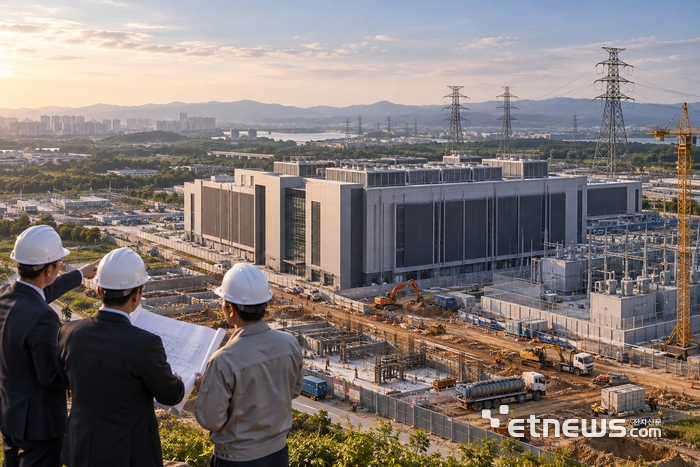
Mastern Investment Management and Digital Edge Korea, a subsidiary of global data center company Digital Edge, plan to build a data center in Paju, Gyeonggi Province. Mastern will be responsible for raising investment capital and designing the financing structure, while Digital Edge will participate in developing the data center infrastructure. The project is estimated to be worth around KRW1 trillion.
According to investment industry sources on Oct. 14, the two companies plan to begin construction of the data center in Paju, Gyeonggi Province, as early as the beginning of next year. The site covers 29,890 square meters, or approximately 9,000 pyeong, a Korean unit of area. Development is expected to take about two years.
The two companies have signed a memorandum of understanding (MOU) with KEPCO Engineering & Construction (KEPCO E&C) for business development cooperation. The parties agreed to collaborate on development, financing and power infrastructure construction. The plan is to generate rental and operating revenue by providing cloud and IT companies with server space and infrastructure, including power and cooling systems.
Mastern will handle investor recruitment, investment structuring and financing. After securing investors and completing internal reviews, the company plans to establish an investment vehicle that will acquire the site and obtain project financing (PF) loans.
Singapore-based Digital Edge will be involved in data center development and the review of major contracts. The partnership combines the financial capabilities of an asset management firm with the development expertise of a specialized data center company.
KEPCO E&C will support coordination of the power supply schedule and construction of electrical infrastructure. Under the electricity supply agreement, power supply is scheduled to begin no later than January 2029. The project will also include construction of two underground power receiving lines for primary and backup supply connected to the Geumchon Substation in Paju, as well as 154-kilovolt gas-insulated switchgear (GIS) and other electrical facilities.
The project's revenue model is based on long-term leasing demand from corporate customers. The data center will provide server installation space and power, cooling and telecommunications infrastructure in exchange for service fees. Investors will be able to receive distributions from operating income or recover their investments through a future sale of the asset.
Industry observers are paying attention to the development of a new data center in the Seoul metropolitan area. The concentration of major companies and demand for cloud services makes the region favorable for securing customers. However, power supply constraints make new development difficult. The two companies plan to work with KEPCO E&C to coordinate the power supply schedule and build the necessary infrastructure to meet demand for data centers in the Seoul metropolitan area.
As demand for data centers increases with the expansion of cloud computing and AI, financial investors, including asset management firms and private equity funds (PEFs), are increasingly entering the development market. In July, IGIS Asset Management completed a hyperscale data center in Goyang, Gyeonggi Province, following its 80-megawatt (MW) Hanam data center. Koramco Asset Management also launched a project earlier this year to develop the 100MW K-Square Data Center Uijeongbu.
“Commercial data centers need sufficient tenant demand to ensure financial viability, which is why financial investors such as asset management firms are focusing on development in the Seoul metropolitan area, where demand is concentrated,” said Song Jun-hwa, secretary-general of the Korea Data Center Energy Efficiency Association.
“However, new development in the Seoul metropolitan area is virtually impossible except on sites that have already secured power capacity. As a result, a 'balloon effect' is emerging, with development demand shifting to northern Gyeonggi Province, including Paju and Uijeongbu, where the power grid has relatively more available capacity,” Song said.
