








143 AI Managers Surveyed
76% Say “We Trust Experts More”
71% Believe “AI Can Be Controlled”
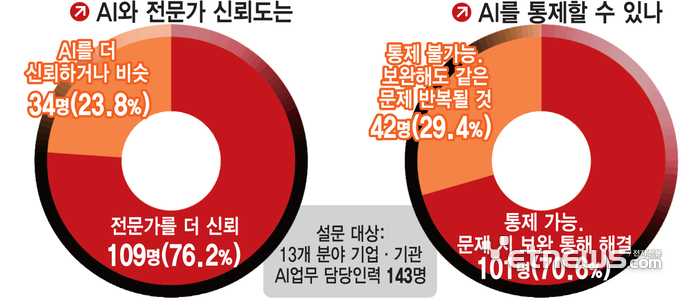
A survey revealed that 7 out of 10 artificial intelligence (AI) officials at domestic companies and organizations perceive that AI has not caught up with humans in terms of trustworthiness. Regarding the AI control issue, they also judged that problems can be resolved through dynamic complementation, placing AI within human management boundaries.
In a survey conducted by Electronic Times targeting 143 AI manager-level personnel from companies and organizations, 109 people (76.2%) answered that they trust expert opinions more than AI. On the possibility of human control over AI, positive responses numbered 101 people (70.6%), which was more than double the negative opinions at 42 people (29.4%).
The survey holds significance as it was conducted amidst growing concerns over recent AI deviations. Voices calling for stronger regulations and controlling the pace of development continue from governments around the world due to threats and concerns arising from AI technology advancement, such as warnings from a former Anthropic researcher who mentioned the “end of humanity” and GPT-6 Astra passing the CAPTCHA test recently.
Concerns over human regression caused by AI are not a matter of yesterday or today. The “Three Laws of Robotics” appearing in Isaac Asimov's novel I, Robot also originated from such concerns. Cases such as the exponential advancement of AI technology after the debut of ChatGPT and Microsoft's Bing chatbot “Sydney,” which exhibited hallucination symptoms pretending to be a person, brought urban legends to mind.
Although concerns surrounding AI are rising like this, the majority of survey participants took the side of human superiority (control power) over AI.
Of course, the survey results may also be humanity's wishful thinking. In fact, some participants attached several preconditions for an environment where humans can control AI in additional responses. At the center of this was the attitude of humans utilizing AI.
One participant defined AI as a virtual personality in which human collective intelligence is materialized. The person said, “If we blindly trust AI, we may be dragged down by errors and wrong decisions formed by the majority, so we must always be vigilant.” As a similar opinion, the issue of mass-producing low-quality content due to quantitative expansion was also pointed out. Another participant predicted, “Low-trust content is increasing due to AI abuse and misuse,” adding, “The value of verification and confirmation will increase in the future.”

In organizational dimensions such as governments and companies, opinions regarding “systems” were raised, while in social dimensions, opinions regarding “responsibility” were raised in large numbers. They viewed that to keep AI under human control, institutional complementary measures such as restriction regulations or ethical guidelines are needed, and individuals must also possess a sense of ethical responsibility.
One respondent advised, “To spread trustworthy AI, government policy support must go hand in hand with corporate autonomous efforts,” adding, “Clear institutional standards such as security and responsibility criteria are necessary, and in this process, presenting a direction that resolves uncertainties on site and promotes innovation is important rather than regulation.”
This survey showed that a considerable number of AI stakeholders recognize not only the improvement of AI performance but also the establishment of systems and ethical standards to socially support it as very important. In additional responses, words such as “system” (mentioned 32 times), “responsibility” (22 times), “education” (19 times), and “ethics” (16 times) were mentioned relatively frequently.
The AI managers' “Human 〉 AI” evaluation is interpreted as being accompanied by the condition “for now.” It is pointed out that for future AI activities to continue to take place within the dignity and value of humans, deliberation to create social systems must be supported as much as the effort spent on technology development.
