








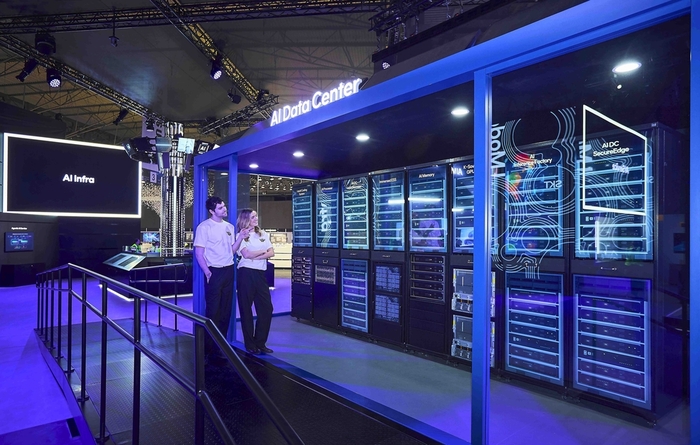
SK Telecom is launching a strategy to expand its Asian AI factory network by securing an additional 5 gigawatts (GW) of artificial intelligence data center (AIDC) capacity overseas. The company aims to establish a total power supply capacity of 20GW, including 15GW in South Korea, and gain a leading position in the token economy by operating intelligent factories that produce and export AI tokens.
According to telecommunications industry sources on Oct. 12, Jung Suk-geun, head of SK Telecom's AI Company-in-Company (AI CIC), recently shared an internal blueprint to build and gradually bring online AIDCs with a combined capacity of 20GW by 2035.
SK Telecom previously announced a target of developing 15GW of data center capacity in South Korea. The company plans to secure an additional 5GW overseas during the same period, positioning itself as a major AI infrastructure hub in Asia.
Japan is the leading candidate for SK Telecom's first overseas base. SK Group Chairman Chey Tae-won previously identified Japan as the company's first target for overseas AIDC expansion in an interview with the Nikkei newspaper. SK Telecom aims to begin operating a gigawatt-scale AI factory in cooperation with Nvidia as early as 2028.
SK Telecom ultimately aims to establish Asia's largest AI infrastructure hub by expanding its network into Southeast Asia. Given the enormous investment required, the company is considering gradually securing 5GW of overseas capacity through joint development and operation with local partners.
SK Telecom's overseas expansion plans are driven by surging demand. U.S. demand for AIDCs is projected to exceed 90GW by 2030. However, power constraints, government regulations and local opposition are expected to limit expansion, worsening the imbalance between supply and demand. SK Telecom believes an Asian AI infrastructure network could attract overseas operations from major U.S. technology companies by offering geopolitical stability and reliable data infrastructure.
Japan has a concentrated semiconductor and materials ecosystem, while government support helps offset high investment costs. Japan's Ministry of Economy, Trade and Industry (METI) subsidizes AI computing resource costs through its Generative AI Accelerator Challenge (GENIAC) initiative, as part of a broader commitment to provide more than JPY10 trillion in public support for AI and semiconductors by 2030.
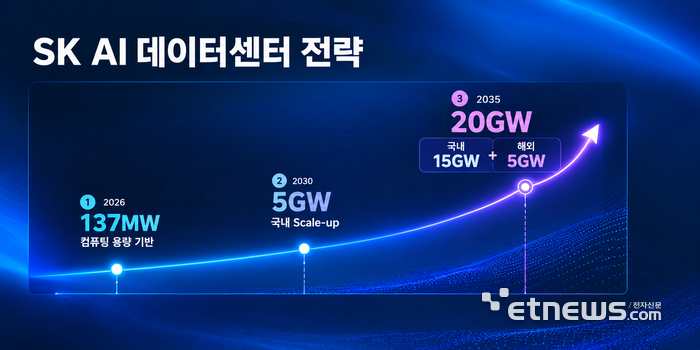
In South Korea, SK Telecom plans to develop more than 2GW of additional AIDC capacity in the southeastern Yeongnam region, starting with Ulsan, and another 1GW in the southwestern region. The company intends to begin bringing 5GW of capacity online in phases from 2029 while also exploring opportunities for overseas expansion.
The infrastructure expansion is tied to new revenue opportunities. SK Telecom believes AI competition is expanding into an ecosystem encompassing the generation, supply and use of tokens, and has identified a “token gateway” as a new growth engine. The service would manage AI usage patterns for businesses and individuals, connect users to the most suitable AI models and infrastructure, and handle the entire process from usage to payment. Major global technology companies are also competing for leadership in this market. SK Telecom envisions generating revenue across the entire value chain, from token production to distribution, rather than relying solely on data center leasing.
Another advantage is SK Telecom's ability to source key AIDC components within SK Group, including high-bandwidth memory (HBM) from SK hynix. The company is also pursuing Memory-as-a-Service (MaaS) as a differentiation strategy, enabling the same GPUs to generate more tokens by adding memory capacity.
