








The Era of AI-Generated Synthetic Consumers Begins
AI Trained on Real Purchasing and Behavioral Data
Predicting Responses to Product Concepts and Prices
Retailers Expand Use of Synthetic Consumers
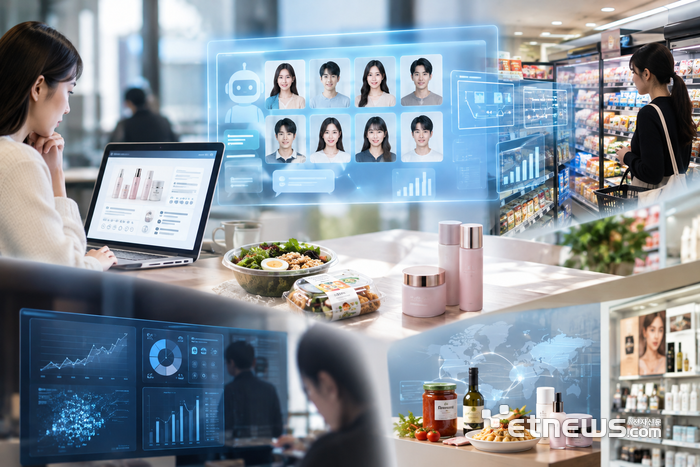
Retail companies are turning to artificial intelligence (AI) synthetic consumers to gauge consumer reactions before launching new products. The technology uses AI trained on actual consumer purchasing and behavioral data to create virtual consumer groups and predict their responses to product concepts, prices and other factors. The retail industry is undergoing changes as applications expand from consumer research and product planning to simulations of store operations.
According to industry sources on Oct. 12, South Korean retailers are adopting AI synthetic consumers for new product planning and development.
Companies present product concepts, prices and designs to synthetic consumers to assess their likely responses. The approach requires less time and money than recruiting real consumer panels and conducting surveys and interviews. It also allows companies to repeatedly test different scenarios by changing various conditions.
BGF Retail, which operates the CU convenience store chain, has been using synthetic consumers for product planning and recently began expanding their use to store operations. Beyond evaluating new product concepts based on predicted consumer responses, the company is pursuing simulations of product displays, customer traffic patterns and merchandise assortments in virtual stores. The goal is to reduce trial and error by evaluating different operating strategies in a virtual environment before testing them in physical stores.
In August, BGF Retail launched a two-piece lunchbox product called “Mini Original Yubu,” developed using synthetic consumers. Cumulative sales exceeded 50,000 units within two weeks of launch. The company also plans to use the technology to develop and introduce new convenience store bakery products.
Food and beauty companies have also adopted synthetic consumers. Lotte Wellfood has used AI synthetic consumers for product concept research since early this year. The company gives equal weight to responses from AI synthetic consumers and actual consumers, then combines the results to calculate a hurdle score used to evaluate product concepts. Lotte Wellfood has conducted approximately 80 concept studies so far, with the findings being incorporated into actual product launches.
CJ CheilJedang has been reviewing and piloting synthetic consumer research since last year, using the findings as reference material for product planning. The company plans to test the technology across various types of research alongside studies involving actual consumers to assess its potential applications.
Amorepacific is conducting synthetic consumer projects with several technology companies. Using solutions for customer, market and product concept research, the company is assessing the reliability of AI synthetic consumers and evaluating their suitability and efficiency for different research topics.
However, further validation is needed to determine how accurately synthetic consumer responses reflect the actual choices and purchasing behavior of real consumers. Retailers adopting the technology are still conducting conventional consumer research alongside AI-based studies to assess its reliability and potential uses. A key challenge going forward will be to validate the technology against actual product launches and sales performance, rather than relying solely on comparisons with conventional research results.
Seo Yong-gu, a professor at Sookmyung Women's University's School of Business Administration, said consumer research that previously took months could now be conducted almost in real time, accelerating product development and narrowing the gap between companies and consumers.
“The industry is likely to see a reassessment of companies based on whether and to what extent they use AI synthetic consumers in the future,” Seo said.
