








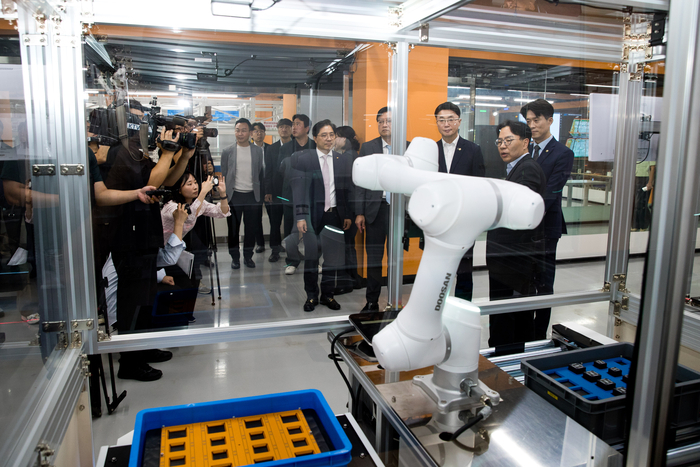
Technological development is accelerating for robots to autonomously classify irregular-sized and shaped mail, cultivate and harvest crops in fields, and automatically unload containers at ports.
As the government allocates 3.1 trillion won in next year's budget for physical AI—one of the three mega-projects—plans for cross-ministerial support to develop and demonstrate core physical AI technologies for industrial applications in manufacturing, logistics, agriculture, and ports have been finalized.
The Ministry of Science and ICT held the '2027 Cross-Ministerial Physical AI Business Briefing' at COEX in Seoul on the 13th, alongside the 'Physical AI Alliance Day.' The event, attended by the Ministry of SMEs and Startups, the Ministry of Agriculture, Food and Rural Affairs, the Ministry of Oceans and Fisheries, and the Financial Services Commission, unveiled ministry-specific project plans and support directions for applying physical AI to real industrial settings.
The Ministry of Science and ICT will invest 26 billion won in national funds next year to develop physical AI technologies for postal logistics in collaboration with the Korea Post. Current logistics automation robots struggle with irregular mail items. The goal is to enable robots to recognize, sort, inspect, and load such items. The project will be announced in March 2025, with two consortia selected to validate the technology in public logistics sites before expanding to the private sector.
Core technology development for the “brain” of robots is also underway. With 55 billion won in national funds next year, the ministry will develop a general-purpose physical AI foundation model, learning simulators using real/virtual data, and low-latency motion control technologies. The aim is to create autonomous AI that adapts to new environments and combines tasks to complete missions, moving beyond repetitive operations. A new project will be announced in January 2025.
The Ministry of SMEs and Startups will expand policy support from digital transformation (DX) to AI transformation in manufacturing. Over three years starting next year, approximately 440 billion won in national funds will be allocated to the new 'Physical AI Demonstration Support Project for Small and Medium Manufacturing Enterprises.' This will apply physical AI to non-standard manual tasks and hazardous processes in labor-scarce manufacturing sites, supporting integrated demonstrations to intelligently transform entire factories. A 'Manufacturing AI 24' integrated platform for data collection, standardization, and utilization will also be established.
In agriculture, the challenge is to establish an autonomous production system where robots farm independently. The Ministry of Science and ICT, Rural Development Administration, and Ministry of Agriculture, Food and Rural Affairs will jointly invest approximately 78 billion won over five years in the 'Development of Core Physical AI Technologies for Korean-Style Unmanned Autonomous Field Agriculture.' This project will develop multimodal perception and control technologies, as well as agricultural decision-making foundation models, enabling farm machinery to autonomously plow, sow, manage, and harvest crops. Target outcomes include a 75% reduction in labor, a 25% increase in production, and a 40% reduction in management costs.
The Ministry of Oceans and Fisheries will focus on automating port cranes and mobile unloading equipment. Next year, 2.92 billion won will be allocated for smart port autonomous unloading technology, and 5.52 billion won for next-generation port operation technologies based on agentic AI. Separately, 7.35 billion won will be used to demonstrate autonomous unloading vehicles (ALVs) in real port environments and verify their performance and commercial viability.
At the event, Deputy Prime Minister and Minister of Science and ICT Bae Jeong-hun presided over a meeting to review the progress of the second Physical AI Alliance, launched in June. He emphasized, “As the Physical AI Alliance has shifted from discussion to action, it is time to demonstrate tangible results that can be felt on the ground. The government will actively link inter-ministerial projects and policy finance to resolve on-site challenges, ensuring that companies jointly plan and demonstrate projects, with outcomes leading to investment and commercialization.”
