




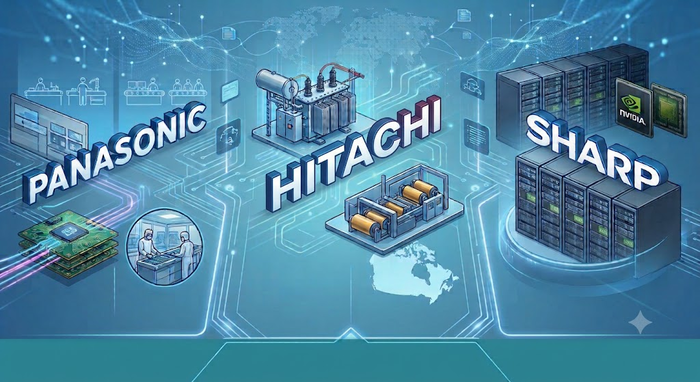
Japanese electronics companies, once leaders in the global home appliance market, are shifting their focus to the artificial intelligence (AI) sector. They are accelerating efforts to capture the hardware supply chain market for essential materials, components, and servers required for AI infrastructure.
Amid fading reputations as appliance manufacturers, these firms are restructuring their business models to lay the groundwork for a new leap forward.
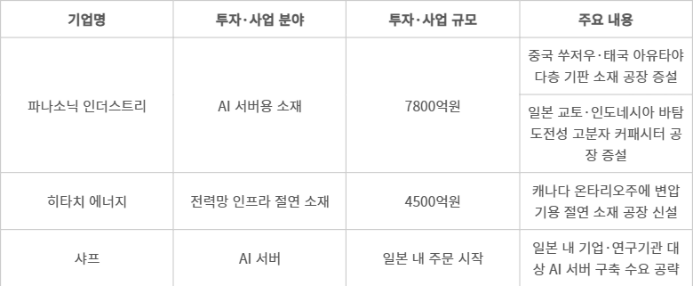
Panasonic Industry is investing a total of 92 billion yen (approximately 780 billion won) to expand production capacity for materials and electronic components used in AI data centers. Of this, 67 billion yen (73% of the new investment) will be allocated to increasing multilayer substrate materials—critical components that support high-speed communication in AI servers.
Panasonic will strengthen its multilayer substrate material supply chain by expanding factories in Suzhou, China, and Ayutthaya, Thailand. Additionally, the company is investing 17 billion yen to expand factories in Kyoto, Japan, and Batam, Indonesia, to meet demand for conductive polymer capacitors, which stabilize current flow in AI server power circuits.
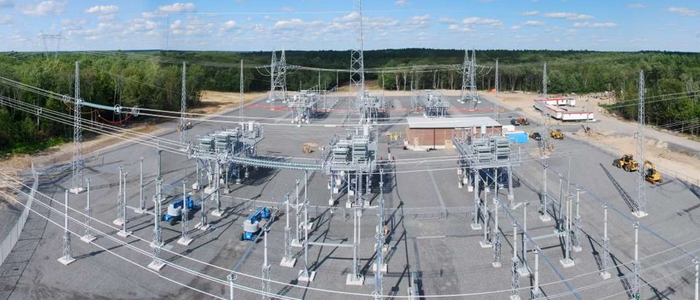
Hitachi Energy is investing 479 million Canadian dollars (450 billion won) to build an insulating material factory for transformers in Ontario, Canada, aiming to resolve power bottlenecks caused by the surge in AI data centers.
This marks Hitachi Energy's first production infrastructure for transformer insulating materials in North America, designed to meet local demand. The company plans to complete the Canadian factory by 2028, enhancing the stability of the region's power infrastructure supply chain.
Sharp, acquired by Taiwan's Foxconn, has entered the AI server market. Sharp has begun receiving orders in Japan for enterprise AI servers equipped with NVIDIA's 'Blackwell' graphics processing units (GPUs). The company plans to expand its lineup with servers based on the next-generation 'Rubin' GPUs, targeting demand from Japanese companies and research institutions that prioritize security and aim to build their own AI servers.
Japanese companies' global production bases and advanced materials technologies are expected to become powerful weapons in the competition for leadership in the AI supply chain. Instead of focusing on declining business-to-consumer (B2C) home appliances, they are strengthening their influence in the business-to-business (B2B) AI hardware market.
An electronics industry official stated, “As the home appliance market has clear growth limitations, domestic companies must swiftly expand their portfolios beyond the appliance sector to the entire AI infrastructure supply chain to enhance their market dominance.”
