








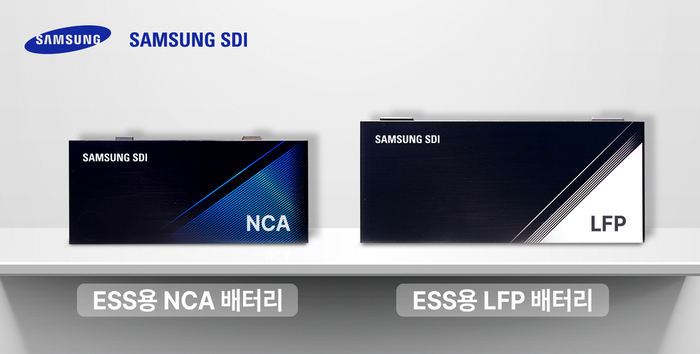
Samsung SDI Co., Ltd. is accelerating the conversion of the production lines at its US electric vehicle (EV) battery factory established in joint venture with the automaker Stellantis N.V. This work reorganizes a production base whose utilization has lowered due to a slowdown in EV demand into a production base to respond to local energy storage system (ESS) demand.
According to the industry on June 24, Samsung SDI issued letters of intent (LOI) to domestic equipment and component companies and entered purchase order (PO) procedures. This is an equipment order to convert some lines of the StarPlus Energy Phase 1 plant in Indiana, United States, into prismatic lithium iron phosphate (LFP) battery production lines for ESS.
It is understood that Innometry Co., Ltd. will supply inspection equipment, Philenergy Co., Ltd. will supply stacking equipment, and MOT Co., Ltd. will supply packaging process equipment. Hanjung NCS Co., Ltd. is expected to take charge of cooling components and systems related to the Samsung Battery Box (SBB), an ESS product. Bestek is reported to be the most likely candidate for electrolyte injectors.
The industry expects that the installation of the LFP line equipment will be completed by the first half of next year, and after going through initial mass production verification, supply volumes will expand from the second half.
An industry official explained, “To convert an EV battery line for ESS use, modification of production facilities including the assembly process is required,” adding, “This equipment order means that the joint venture plant's ESS conversion is moving into the actual production preparation stage.”
Currently, out of a total of four lines at the StarPlus Energy Phase 1 plant, three lines are being converted for ESS. Among them, one line has already been converted into an NCA (nickel, cobalt, aluminum) battery line for ESS and is operating at a scale of about 7 GWh, and the remaining two lines were identified as prismatic LFP battery lines with a scale of about 12 GWh per line.
Samsung SDI's move to convert lines for ESS is interpreted as a movement to secure the North American ESS market as a new growth axis amid the growth slowdown of the EV market.
According to energy market research firms SNE Research and BloombergNEF (BNEF), the US ESS market size is projected to expand from 88 GWh last year to 485 GWh in 2030. Although LFP batteries have a lower energy density than NCA, they have strengths in price competitiveness and safety, so they are mainly used for ESS.
Samsung SDI is a non-Chinese company capable of supplying prismatic batteries in the United States, and if it secures local LFP production capacity, its responsiveness to the North American ESS market is expected to increase. Based on the line conversion, it plans to expand its ESS production capacity in the United States to 30 gigawatt-hours (GWh) annually by the end of this year.
It has also secured battery supply customers. In December last year, it signed an agreement with a US energy company to supply LFP batteries for ESS for three years starting from 2027. The scale exceeds 2 trillion won, which is the first LFP battery order for Samsung SDI.
