






Chinese companies surpassed South Korean rivals in unit-sales share across all five major home-appliance categories—including TVs and refrigerators—in the global market last year. The shift reflects China's expanding influence through high-volume production of mass-market products, while South Korea's domestic appliance output and exports declined.
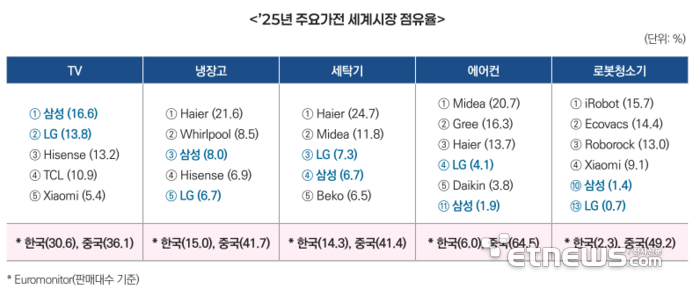
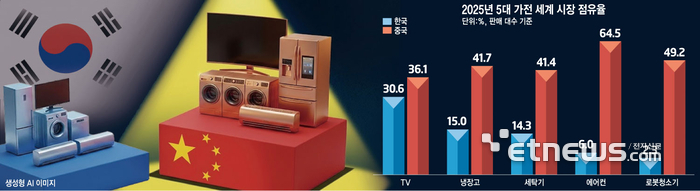
According to Strengthening Manufacturing Competitiveness in Korea's Home-Appliance Industry in the Physical AI Era, a report published by the Korea Electronics Association (KEA), Chinese companies accounted for 36.1% of global TV sales by unit volume last year, compared with 30.6% for South Korean companies.
The gap was wider in other appliance segments. In refrigerators, South Korean companies held a combined 15.0% share of global unit sales, while Chinese companies captured 41.7%. Even Samsung Electronics' 8.0% share and LG Electronics' 6.7% share combined fell short of Haier's 21.6%.
The pattern was similar in washing machines. LG Electronics held a 7.3% share and Samsung Electronics 6.7%, far behind market leader Haier at 24.7%. Chinese companies collectively accounted for 41.4% of global washing-machine sales—roughly three times South Korea's share.
South Korean companies had an even smaller presence in air conditioners and robot vacuum cleaners. LG Electronics ranked fourth in the global air-conditioner market with a 4.1% share, while Samsung Electronics ranked 11th with 1.9%. Their combined share was just 6.0%, compared with 64.5% for Chinese companies.
In robot vacuum cleaners, Samsung Electronics and LG Electronics held shares of 1.4% and 0.7%, respectively, placing neither company in the global top 10.
China's rise, however, extends beyond an expansion in low-cost products.
“The rise of Chinese companies is not simply the result of price competition, but of an ecosystem-integration strategy,” the report said. “They are transforming into comprehensive global companies spanning product development, manufacturing, distribution, services and platforms, using consumer touchpoints and data as new competitive assets.”
While Chinese appliance makers have advanced rapidly, South Korea's appliance production and exports have declined. Domestic appliance production totaled KRW16.5 trillion last year, down 11.1% from a year earlier. That represents a decline of KRW2.5 trillion in three years from KRW19 trillion in 2022.
Home-appliance exports also fell from USD 8.03 billion to USD 7.27 billion over the same period, with exports declining 8.8% last year.
KEA warned that weakening production capacity is not merely a matter of lower manufacturing volumes. The report cited Japan's home-appliance industry as a cautionary example.
“During business sales and joint ventures, Japanese appliance companies transferred not only their brands but also design, production, sales and service capabilities,” the report stated. “Japan's experience suggests that maintaining leadership in the appliance industry requires preserving manufacturing, service and consumer touchpoints alongside the brand itself.”
KEA argued that South Korea must urgently prioritize strategically selected areas to secure future competitiveness and strengthen the manufacturing base of its home-appliance industry.
As one measure, the association proposed including AI premium appliances in the proposed domestic-production tax credit, which the government announced on the 3rd as part of its tax-code revision.
AI premium appliances integrate key technologies and advanced components—including semiconductors, artificial intelligence, sensors, robotics and advanced materials—into finished consumer products. KEA argued that tax incentives should be used to encourage their production in South Korea.