






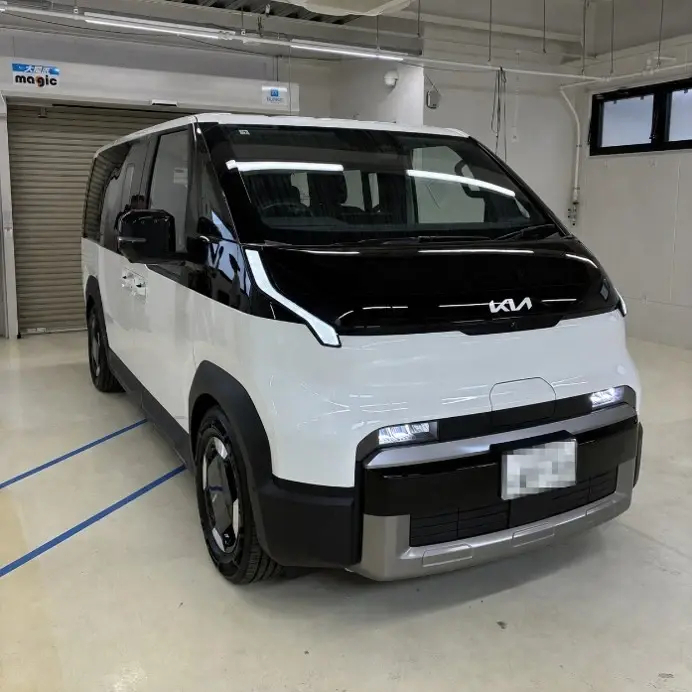
Kia has kicked off its targeting of Japan's local business-to-business (B2B) future mobility market by supplying its first dedicated purpose-built vehicle (PBV), the “PV5,” to NEC, a representative IT and telecommunications company in Japan.
This supply is highly significant in that Kia delivered an “integrated SDV (software-defined vehicle) solution” combining hardware and software—such as fleet management systems (FMS) and infotainment—beyond simple finished vehicle sales to a major Japanese enterprise.
According to the industry, Kia was confirmed to have recently supplied the “PV5 Passenger,” a passenger model of the PV5, to NEC. While the exact initial delivery volume is undisclosed, the vehicles will be deployed in next-generation smart mobility and local government transportation service verification projects pursued by NEC. This marks the first time Kia has supplied an actual PBV to a local Japanese company.
This supply aligns with projects addressing Japan's facing issues of population aging and resolving public transportation blind spots in regional areas. To respond to the shortage of bus and taxi drivers and the collapse of public transport infrastructure, Japan's Ministry of Land, Infrastructure, Transport and Tourism is pursuing a project to distribute 10,000 electrified and autonomous mobility service vehicles to transportation-vulnerable areas nationwide by 2030. NEC plans to build next-generation mobility solutions, such as public demand-responsive transport (DRT) services, utilizing Kia's PV5.
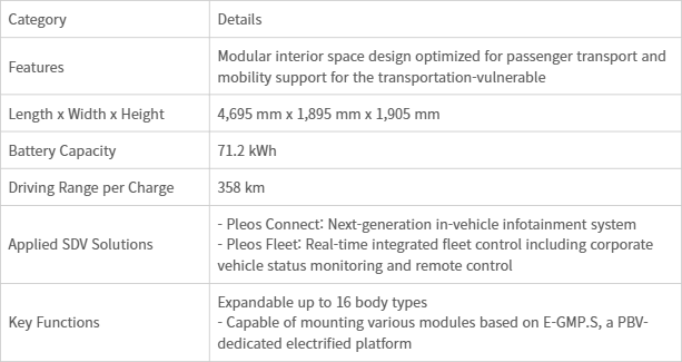
In particular, both companies will cooperate not only in vehicle supply but also in the verification of connected car and autonomous driving services combining communication networks and software. Hyundai Motor Group's next-generation infotainment system “Pleos Connect” and corporate fleet integrated management solution “Pleos Fleet” are applied to the PV5. Combined with NEC's 5G telecommunication infrastructure, real-time implementation of vehicle status monitoring, remote control, and driving data analysis will be realized, while joint promotion of autonomous driving service verification is also planned.
Developed based on Hyundai Motor Group's PBV-dedicated electric vehicle platform “E-GMP.S,” the PV5 features maximized interior space utilization through a modular design. The PV5 Passenger supplied this time is equipped with a 71.2 kWh capacity battery, capable of driving 358 km on a single charge, and can flexibly respond to passenger transport as well as mobility support for the transportation-vulnerable. Kia plans to expand its supply lineup in the future with the “PV5 Wave,” specialized for wheelchair boarding, and the large-sized PBV “PV7.”
An industry official said, “Japan is a market with a very high entry barrier for foreign automaker companies due to high loyalty to domestic automaker brands,” adding, “As Kia secures the local IT giant NEC as a client following the establishment of a distribution network with Sojitz, a Japanese general trading company, it has secured a powerful reference in the Japanese public and logistics PBV market.”