








Korean Air has finalized a $44.8 billion procurement package for 103 Boeing aircraft, spare engines and long-term engine maintenance services, completing an agreement first outlined in Washington in 2025.
The carrier said on Sep. 16 that it had finalized contracts with Boeing, GE Aerospace and CFM International valued at about 60 trillion KRW. The package includes $36.2 billion for 103 next-generation Boeing aircraft and a separate $8.6 billion agreement for spare engines and maintenance support.
Korean Air will acquire 20 Boeing 777-9 widebody passenger jets, 25 787-10s, 50 737-10 narrowbody aircraft and eight 777-8 Freighters. The airline will also purchase 21 spare engines from GE Aerospace and CFM International, while GE Aerospace will provide engine maintenance services for 28 aircraft over 15 years.
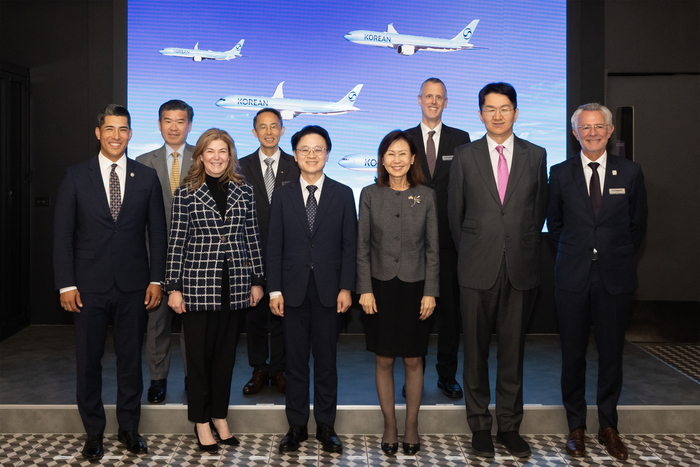
The contracts were commemorated at a signing event co-hosted by Korean Air and Boeing. They formalize a memorandum of understanding for aircraft purchases, engines and associated services announced in Washington, D.C., in August 2025.
“The commitment we made in Washington last year has now come to fruition through final contracts, which makes this a particularly meaningful moment,” Hanjin Group Chairman and Korean Air CEO Walter Cho said. “This is more than a business transaction. It is a milestone of trust that further strengthens the firm economic and technological alliance between South Korea and the United States.”
Korean Air said it will use the next-generation, fuel-efficient aircraft to modernize its fleet, improve operational efficiency and expand passenger and cargo capacity. The airline also expects the investment to enhance customer service and reinforce its long-term competitiveness.
The company described the agreement as the result of close communication and support between the South Korean and U.S. governments, rather than a transaction solely between private companies.
The South Korean government supported the initiative through policy measures and regulatory improvements aimed at strengthening the country's aviation industry. State-backed financial institutions, including the Export-Import Bank of Korea, also expressed their willingness to provide financing cooperation to support the large-scale investment.
