






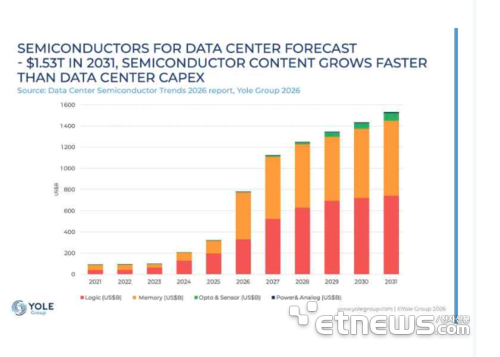
The global market for data center semiconductors is projected to reach $1.5 trillion by 2031, with competition shifting from individual chip performance to full-rack system optimization, according to market research firm Yole Group.
In its Data Center Semiconductor Trends 2026 report, Yole Group forecasts that the data center semiconductor market will more than double this year from 2025 levels. It expects the market to keep expanding and surpass $1.5 trillion—roughly KRW 2,000 trillion—by 2031.
The firm said AI is rapidly increasing both semiconductor demand and the share of total data center value captured by chips. It argued that AI-system performance is no longer determined solely by the capabilities of a single graphics processing unit, or GPU, or AI accelerator. Instead, the competitive unit is shifting from the chip to the entire server and rack.
Major AI infrastructure platforms are already moving in that direction. Systems including Nvidia's NVL576, AMD's Helios, Amazon Web Services' NL72 and Google's Ironwood are being designed as rack-scale architectures that integrate compute chips, memory and networking.
The shift reflects an effort to optimize not only compute performance, but also memory bandwidth, data-transfer speed and power efficiency across the entire system.
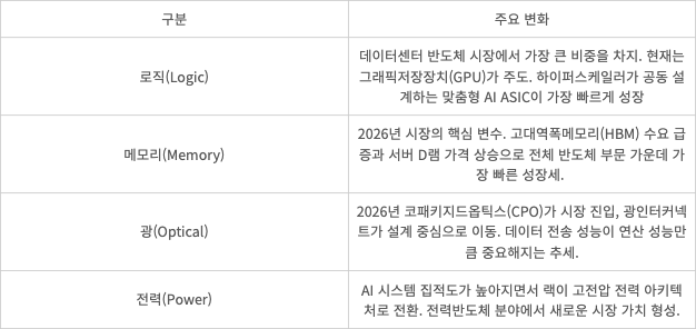
Yole Group identified memory as the fastest-growing segment in the data center semiconductor market this year. Demand for high-bandwidth memory, or HBM, is surging as AI accelerators become more widely deployed, while rising server DRAM prices are adding further momentum to the segment.
Advanced packaging and optical interconnects are also becoming increasingly important. Rapid progress in HBM road maps is raising demand for advanced-packaging capacity capable of integrating these memory stacks. At the same time, internal data-transfer performance within data centers is becoming as critical as raw compute performance.
Power is emerging as another major source of value. Yole Group expects AI racks to approach 1 megawatt of power consumption around 2030, driving broader adoption of 800-volt high-voltage power-delivery systems, silicon-carbide and gallium-nitride power semiconductors, and direct liquid-cooling technologies.
“AI has transformed data centers into a full-system challenge,” Eric Mounier, principal analyst at Yole Group, said. “Performance is now sold at the rack level rather than at the chip level. Competitiveness will depend on how effectively companies combine memory, advanced packaging, optics and power efficiency.”