








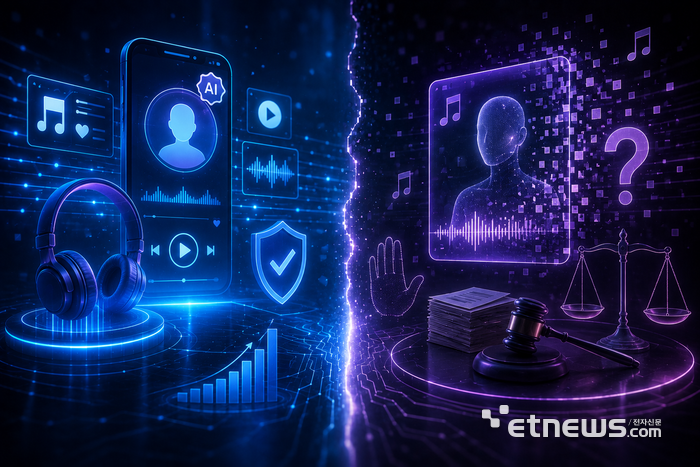
Spotify and other global music streaming platforms are swiftly responding to generative AI in music, as seen in the recent introduction of the 'AI Persona' feature. In contrast, domestic platforms have yet to establish related standards and remain in a wait-and-see stance.
According to industry sources on the 17th, as generative AI-created music floods the streaming market, efforts to manage it within distribution systems are accelerating.
Spotify will introduce 'AI Persona' badges starting in September. These badges indicate that an artist's identity may be AI-generated and not a real person, informing listeners. Spotify explained, “Listeners don't want to later discover that a seemingly human profile is actually AI-generated.” AI-generated music will also be excluded from recommendation algorithms.
French platform Deezer, after identifying a significant portion of incoming new tracks as AI-generated, implemented a system to automatically detect and tag AI music, excluding it from algorithmic recommendations and excluding fraudulent streams from payment eligibility.
In South Korea, however, AI music's entry into institutional frameworks is still in its early stages. Major domestic platforms like Melon, Genie, and Flo only passively reject fully AI-generated music (created solely via prompts without human creative input) during distribution reviews. Unlike global platforms, they lack AI music detection, labeling, or separate management policies.
Discussions on copyright registration—the first step in establishing standards—have just begun. The Korea Music Copyright Association (KOMCA) recently introduced new criteria on the 3rd, allowing registration of AI-assisted music where humans played a substantial and leading creative role. However, AI-generated works from simple prompts remain unregistered. While this marks the first case of setting registration and management standards for AI-assisted music, it has faced backlash from creators and political circles.
Rep. Kim Jae-won of the Jai Josun Innovation Party, a former creator, held a press conference on the 10th stating, “No social consensus or legislative conclusion has been reached on AI music copyright issues. It would be wrong to set a precedent where a specific organization unilaterally establishes rules, forcing parliamentary discussions to follow that direction.” A policy debate co-hosted by KOMCA and Rep. Kim's office was canceled a day prior.
Ultimately, without legal frameworks, social consensus, and proper copyright registration and compensation systems, domestic platforms' responses to AI music will continue to lag.
Platforms argue that trust organizations must first set their stances before they can formulate policies. A music platform official stated, “Platform policies are shaped only after trust organizations like KOMCA establish their positions, so we're still in the collaborative deliberation phase.”
