






Lam Research Files Consecutive Lawsuits Against 6 Companies
Korean Parts Enter Manufacturers' Supply Chains
Conflicts Grow as Foreign Replacements Increase
Government Support Needed for IP Strategy Establishment

Patent and design right disputes between global semiconductor equipment companies and domestic Korean parts manufacturers are intensifying. As the aftermarket—where parts companies trade directly with semiconductor manufacturers without going through equipment makers—grows, securing intellectual property (IP) competitiveness has emerged as a new challenge for the domestic materials, parts, and equipment industry.
According to the industry on August 19, the Seoul Central District Court is expected to deliver its first-instance ruling soon on an edge ring design right infringement lawsuit filed by U.S. semiconductor equipment maker Lam Research against BCNC. Separate from the invalidation trial for design registration conducted by the Intellectual Property Trial and Appeal Board (IPTAB), this is a case where the court determines whether BCNC's product actually infringed Lam Research's registered design.
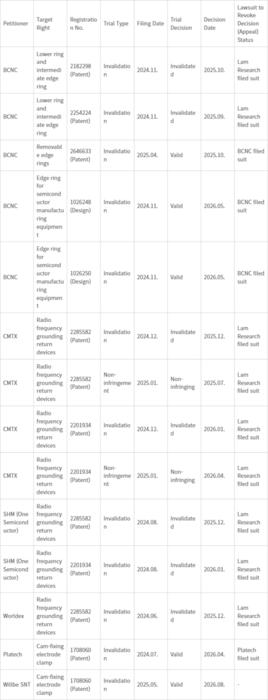
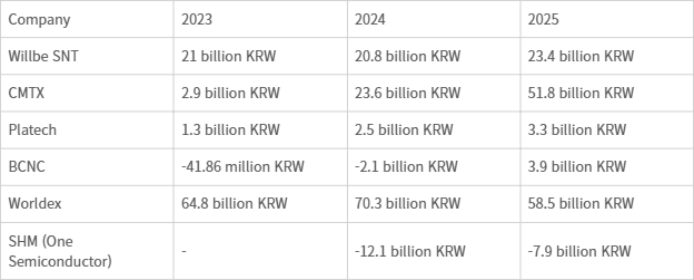
BCNC is not the only company facing such IP disputes. Domestic semiconductor parts makers including CMTX, SHM, Worldex, Platech, and Willbe SNT are engaged in disputes with Lam Research over patents and design rights. CMTX, SHM, and Worldex are battling Lam Research over the same patent related to the C-Ring, which applies radio frequency (RF) grounding technology. Platech and Willbe SNT are in dispute with Lam Research over patents related to clamps that fix electrodes.
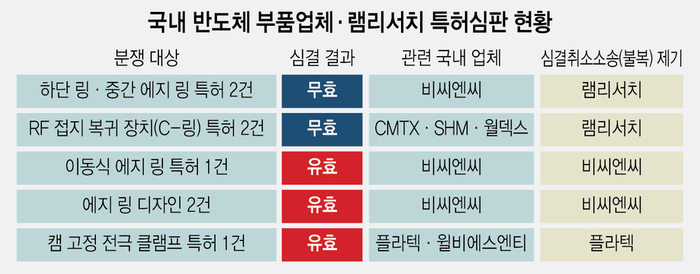
Among the eight patent and design disputes between Lam Research and six domestic companies, IPTAB has issued invalidation decisions in four cases and rejected invalidation trial petitions in four cases. For patents that received invalidation decisions, Lam Research is appealing, while domestic firms are appealing in cases where rights were maintained, filing lawsuits for revocation of trial decisions at the Patent Court.
Unlike equipment whose sales end after a single purchase, these parts experience recurring replacement demand during process operations. As a market that can generate steady revenue, it is an area where the interests of global equipment firms and domestic parts manufacturers directly intersect.
Behind the series of lawsuits lies the rapid growth of the domestic aftermarket. Previously, replacement parts for etching equipment relied heavily on original products (before-market) from global equipment manufacturers. However, the market structure shifted as domestic companies developed alternatives and entered the supply chains of major semiconductor manufacturers such as Samsung Electronics and SK Hynix. Clients are also increasing their adoption of domestic parts to lower component unit costs and diversify procurement sources.
The growing presence of domestic companies in the replacement parts market is unwelcomed by global equipment makers. In particular, silicon parts for etching equipment were a market dominated by global equipment firms like Lam Research. As direct supply to fabs by domestic parts companies has increased in recent years, the aftermarket share has risen to around 30%. This serves as the background for the escalating competition between incumbent equipment makers and domestic parts manufacturers.
If patent disputes persist for several years, litigation costs themselves can become a heavy burden on domestic small and medium-sized materials, parts, and equipment companies. Losing a lawsuit may require not only stopping sales of the product or making design evasions, but also undergoing re-approval procedures with clients. Industry observers evaluate that IP competitiveness is surfacing as a vital business capability on par with technological strength and client certification.
“Small and medium-sized materials, parts, and equipment enterprises have limited capital and specialized personnel, making it difficult to allocate costs to sufficient intellectual property (IP) analysis from the early stages of development,” said Sung-yool Choi, head of the Materials, Parts, and Equipment Technical Advisory Group at the Korea Advanced Institute of Science and Technology (KAIST). “While there are current IP-R&D support programs for small and medium-sized enterprises, there is a need to expand the scope and scale of support so that companies can adequately perform Freedom to Operate (FTO) investigations and IP strategies during actual development.”
Choi added, “In particular, if a large enterprise receives public support such as tax incentives and infrastructure from the government or local municipalities, discussions are needed on ways to contribute to the domestic industrial ecosystem proportionally, such as expanding cooperation with domestic small and medium-sized materials, parts, and equipment firms or engaging in IP cross-licensing.”