


Google is developing a plan to support South Korea's geospatial industry and startups, in what is seen as a move to meet government requirements ahead of transferring high-resolution, 1:5,000-scale map data overseas. Industry representatives say the plan must go beyond broad pledges and include concrete investment commitments.
According to industry sources on Nov. 4, Google Korea is preparing to hold a closed-door forum on cooperation with the geospatial industry on Nov. 23. The event aims to explore ways to help Korean startups expand globally, and discussions are reportedly underway over government participation.
Google Korea has hosted its App Ecosystem Forum since 2020 and its Responsible AI Forum since 2024. In July, it held the “2026 Responsible AI X App Ecosystem Joint Forum,” the first joint event of the two forums under its Digital Responsibility Committee. Discussions covered principles for responsible AI development and the impact of AI and other technology trends on Korea's app ecosystem. A forum specifically focused on cooperation with the geospatial industry, however, is an unusual step for the company.
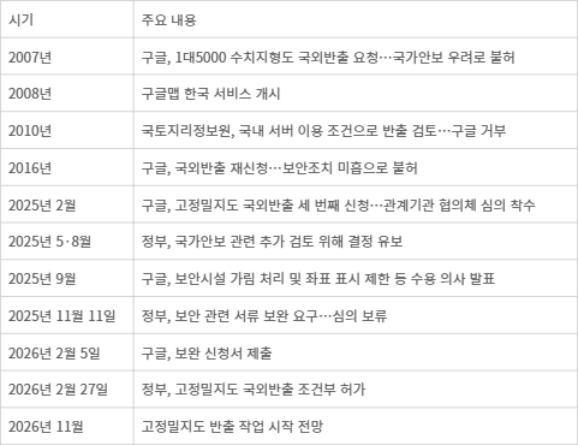
Platform and geospatial industry observers therefore view the event as an opportunity for Google to flesh out the cooperation measures required under its map data export approval. In February, the government's interagency council overseeing overseas transfers of surveying data conditionally approved Google's request to export 1:5,000-scale map data. Alongside security requirements, it called for a plan to support the development of Korea's geospatial industry and related sectors, including AI, and contribute to balanced growth across the country. Presenting that plan could pave the way for Google to move ahead with the transfer.
Attention is now turning to whether Google will propose practical measures, such as partnerships with Korean companies or support for local geospatial startups expanding overseas.
“Google has previously said it would work with Korea's geospatial industry, but those statements were closer to an exercise in justifying its plans,” an industry representative said. “We need to see the details to determine whether it will actually invest.”
Google is expected to strengthen its market position if it transfers the high-resolution map data overseas and uses it to roll out a fuller range of services in Korea. According to Mobile Index, Google Maps had 10.5 million monthly active users in Korea last month, ranking third behind Naver Map at 31.21 million and KakaoMap at 13.82 million. Google Maps first crossed the 10 million mark in July, with 10.13 million users, and has remained above that threshold for four consecutive months.
Local geospatial startups are expected to face increased pressure if Google uses the detailed map data to introduce AI-powered navigation and other services in Korea. Industry representatives say its cooperation plan must therefore include enforceable commitments rather than remain a statement of intent.
“Even a conditional approval to export high-resolution map data is a matter of livelihoods for many Korean businesses,” an academic in the geospatial field said. “Google needs to implement predictable cooperation measures, including advance notice of changes to its application programming interface, or API, pricing.”
“Given that Korea is providing geospatial data produced with taxpayers' money free of charge, Google should not view itself simply as an outside participant,” the academic added. “The geospatial industry connects stakeholders across data production, distribution, processing and use, as well as mapping platforms. Google's plan must address all of them.”